 Deutsche version hier
  I
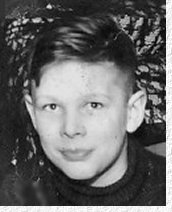
was born in 1932 and 1939 was the year when I finally could attend elementary
school. I had been held back because my mother was working full time.
It was my grandmother, who took me to school. I was happy in my hand-me-down
clothes (from an older cousin). I was also holding my colourful dunce
cap. Well, it was not a dunce cap but a sugar bag, shaped like a pointed
witch's hat. This is an old German tradition that on your first school
day you received such a bag filled with fruit and sweets. I was fascinated
so much by all these sugar bags that I remember nothing else about my
first day in school.
I
was born in 1932 and 1939 was the year when I finally could attend elementary
school. I had been held back because my mother was working full time.
It was my grandmother, who took me to school. I was happy in my hand-me-down
clothes (from an older cousin). I was also holding my colourful dunce
cap. Well, it was not a dunce cap but a sugar bag, shaped like a pointed
witch's hat. This is an old German tradition that on your first school
day you received such a bag filled with fruit and sweets. I was fascinated
so much by all these sugar bags that I remember nothing else about my
first day in school.
Other people had different experiences. Here are examples from friends: "From the first day of school in 1933 we swallowed our daily portion of indoctrination." And another comment: "In 1934 I started school. I learned that the Germans were the master race. They were blond and tall. This confused me because I was short and brown haired."
I did not notice this indoctrination myself, maybe I was too naive. Herbert, who had started school together with me, is a much better observer. He wrote about that day: "Right after Easter life began to be more serious, I became a student. Our teacher drew a picture on the blackboard. She drew a mountain ('berg' in German) with a crown on top. (Krone) then she announced: 'My name is Frau Kronenberg.'" I was the only one to forget her name. On August 23, The Nazis signed a non aggression pact with the Soviet Union. That did not mean much to me. But when Russian grain rolled in and was stored in our gymnasium I could see the purpose. It was done to deprive us from the use of these facilities.
Jews had difficult times throughout the Nazi era. Beatings, persecutions, suicides and murders were common. We children were not aware of this terror. But we cannot say we were totally unaware. The problem was that we had no one to talk to. When I asked question, of my mother, my grandmother and my uncles, I was told that we do not speak of these things. Not many Jews lived in our neighbourhood, if any. But every so often we saw a person wearing a large yellow star. From school, radio, Hitler Jugend and Bund Deutsche Mädel we knew that Jews had been criminals who deserved to be put against the wall (shot).
One day in 1941, at nine years of age, I wandered around the Grasbrook Island where in 1401 the magistrate of the Hanseatic City Hamburg had the most famous pirate Klaus Störtebeker beheaded. I did not know then, but I was actually walking on grounds that lead to death. I came to an old railroad siding of the former Hanover Station. Here I spotted several hundred people shuffling about. Surrounding them I saw soldiers in black uniforms (SS). I noticed that the badly dressed people were wearing yellow stars. The situation looked too dangerous for me and I tried to sneak away. A voice called me back: "Come here boy." It was one of the SS Guards calling. What could I do? I had to go to him. He wanted to know what I was doing there. I was so scared that I could hardly answer. "Are you a Jew?" "What me, a filthy swine NO WAY!" "Good, piss here." "But I don't have to." "Makes no difference, just let me see your pisser." I did not understand but I had to obey. "Thank your parents that you have a foreskin. Now run home and never tell anyone what you saw here today." So I went home and I never talked about this to anyone. I knew that Jews were transported to Poland to be slave labourers on German farms. What was wrong with that? Why was I not to talk about it?
Ferdinand Drewin was born in 1932. He lived in Hamburg till 1943 and later in a small town near the Dutch border. In 1959 Ferdinand emigrated to Canada where he still lives in Edmonton.
 Ferdinand
Drewin
Ferdinand
Drewin July 2007


