 I
was born in Oxford in my maternal grandfather’s house. My father,
an officer in the Royal Engineers, had just been posted to York where
we spent the earliest years of my life. When I was 3 my father was posted
to India and took us with him, returning when I was 8.
I
was born in Oxford in my maternal grandfather’s house. My father,
an officer in the Royal Engineers, had just been posted to York where
we spent the earliest years of my life. When I was 3 my father was posted
to India and took us with him, returning when I was 8.
I remember the start of war in 1939. By that time my father had retired and we were living in Wokingham. My father had organised an air-raid shelter to be built in the garden and was immediately back in uniform. I was 13 and at school.
At the age of 17 I was sent to Shrewsbury for a year’s course at a Domestic Science College.
The really big change in my life came in 1943 when I joined the First Aid Nursing Yeomanry - shortened to FANY and now known as the Princess Royal's Volunteer Corps.
This was, and still
is, a voluntary organisation of resourceful women keen to serve their
country. They have been assisting both Civil and Military authorities
since 1907. The women come from all walks of life, and are united in their
aim to be of service in whatever capacity is asked of them.
The FANYs were recommended by a friend of my mothers who had been
a first World War FANY. Only when attending an induction course, did I
find I was, as a FANY, to be trained to serve with the top secret Special
Operations Executive. This had been formed from the three existing intelligence
organisations in July 1940 on Winston Churchill’s orders. I then
trained as a wireless operator. The job was to act as a communications
link with agents who were dropped by parachute into enemy territory.
As it turned out, and still in training, a number of us were stricken with a serious ear infection passed on by using unsterilised earphones, badly affecting our hearing. This put us on the sick list for quite time. I was not ready to be in action for D. Day. Instead I was sent for a month to a Station in Scotland where I could continue my practice in using the Morse code.
I had already volunteered to serve in India, and under 21 years of age it had to be with my parents’ written consent. Back in London we got ready to travel, were given supper at Lyons Corner House and then in the wartime blackout marched down Park Lane, and, although we could barely see her, ordered to Eyes Right as we passed a very senior FANY waiting to return our salute. We then collected our luggage and were off train overnight, from where to where we did not know (in wartime no stations had their names up) until we eventually arrived at Greenock. From there we sailed and in three weeks we were in Bombay and thence by rail to Meerut.
Although my job in Meerut was only involved in routine communications between Stations, and not with agents behind the enemy lines, I was usefully occupied until a number of us FANYs, including myself, were smitten with jaundice (infective hepatitis).
Once well again and quite early in 1945 I was transferred with a colleague to Ceylon, first in Columbo. I remember working on night duty, searching for those call-signs scheduled to be getting in touch, often difficult to distinguish under the stronger sounds from shipping and others using a similar frequencies.
After a week or so I was transferred with others to a camp inland, in a coconut grove, not far from gum trees and paddy fields. Tropical wild life of all sorts took some getting used to – for instance walking politely round a snake sunning itself curled up in your path. The accommodation was built of platted palm branches which rustled with insects, lizards and giant spiders; cockroaches and giant bats (sometimes called flying foxes) out in the open and the hazard of falling coconuts. We were called in the morning with tea boiled in a bucket with sweetened condensed milk served in a broken-off beer bottle and a green but delicious banana (I ignored the former and ate the latter).
We celebrated, first Peace in Europe and then Peace in Asia, both in this camp. Our job had contributed towards the retraining for jungle warfare those brave people who had already been dropped into France or Holland preparing for, and then sharing in the battle with the allies after the Normandy landings. I remember a young woman and her fiance, both parachutists, who chose that moment to be married in Colombo. I was present.
I also met in that camp a French-speaking Canadian who turned up 5 years later, through no link with me, as fiance and later the husband of a French girl I had got to know in Normandy in 1947.
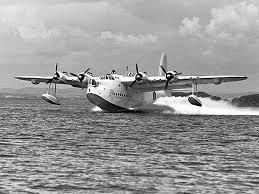 After
the atomic bombs were dropped finally Japan surrendered. We FANYs were
no longer needed and that meant that we could go home, and this was by
a brand-new BOAC Sunderland Flying Boat, and so the last adventure was
the journey home.
After
the atomic bombs were dropped finally Japan surrendered. We FANYs were
no longer needed and that meant that we could go home, and this was by
a brand-new BOAC Sunderland Flying Boat, and so the last adventure was
the journey home.


